WGO @ Hain Celestial? Turnaround Tested Amid Deep Losses

TLDR
Performance Problems: Sales down double digits; goodwill impairments driving huge losses.
Leadership Response: Interim CEO pushing cost cuts, portfolio exits, and a leaner regional model.
Credibility Test: Strategy echoes past promises—investors must weigh action vs. repetition.
Where Hain Celestial Is Struggling
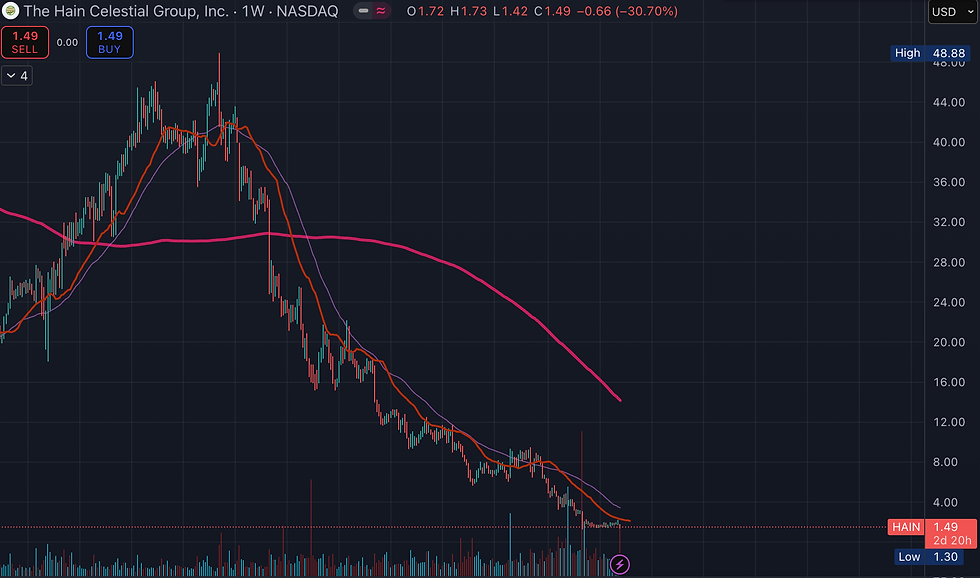
Hain Celestial closed fiscal 2025 with net sales down 10% year-over-year to $1.56 billion and a net loss of $531 million. Q4 alone brought an adjusted net loss of $2 million, while reported losses ballooned to $273 million, largely from $252 million in impairment charges.
Weakness was broad-based:
North America: Organic sales fell 14% in Q4, hit hardest by snacks, with volumes collapsing and gross margin falling 340 bps to 19.2%.
International: Sales dipped 6%, with soup and beverages soft, margins also compressed.
Categories: Snacks declined 19%, Baby & Kids down 9%, Beverages down 3%, and Meal Prep down 8%.
This erosion reflects distribution losses, poor innovation cadence, and muted pricing actions—all compounded by higher trade spend and inflation.

Management’s Playbook: Bold Moves or Déjà Vu?
Interim CEO Alison Lewis framed the turnaround as “five actions to win”, but beneath the headline are structural changes — some promising, others untested.
Cost Restructuring and Leaner Model: Hain is targeting a 12% SG&A cut through headcount reductions and “unwinding much of [its] global infrastructure.” The company is shifting to regional operating models, with supply chain and commercial teams empowered locally. To accelerate accountability, Lewis even eliminated the President of North America role, taking direct control herself.
Risk: Concentrating execution in the hands of an interim CEO raises continuity questions if leadership transitions again.
Portfolio Simplification: Complexity has bogged down execution: “Complexity in our business across our operating model and our portfolio has hampered our ability to move with speed,” Lewis admitted.
Celestial Seasonings tea will shrink from 91 blends to under 55 in two years.
The Yves meat-free line in North America is being discontinued, along with its plant.
Personal Care remains on the block.
With Goldman Sachs advising on a strategic review, more exits are expected. The open question: is Hain slimming into focus, or shrinking into irrelevance?
Innovation Reset: Past missteps left Hain lagging rivals, especially in snacks. Management is now touting its “largest innovation pipeline in recent history,” including:
Garden Veggie Straws & Puffs revamped with avocado oil, real cheese, and cleaner salt profiles.
Hartley’s Juicy Jelly Pouches (U.K.), already showing strong retailer orders.
Celestial Seasonings Anytime Wellness, entering functional tea beyond sleep.
Greek Gods Yogurt expanding into single-serve formats.
U.K. Soups in larger family packs, with early data showing 70% incremental growth to Hain.
These launches are being paired with a shift to digital-first marketing and heavier investment in e-commerce, where Hain’s share is small but growing.
Revenue Growth Management & Pricing: A self-inflicted wound: prior leadership avoided major pricing during peak inflation, leaning only on productivity. Lewis is reversing course:
Pricing already implemented across tea, baby/kids, and meal prep in North America.
Snacks pricing initiatives, including premiumization, are planned this year.
Trade spend is being overhauled, with management pledging a 50 bps reduction in FY26.
Productivity & Working Capital Discipline: Hain delivered $67M in productivity savings in FY25 (~5.5% of cost of goods sold). For FY26, the target is $60M+ savings before inflation.
Distribution centers are being restructured for efficiency.
Inventory coverage will be reduced to free up cash, critical as days inventory outstanding rose to 88 in FY25.
Days payable improved sharply from 37 in FY23 to 65 in FY25, with a goal of 70+ by FY27.
Digital & E-commerce Push (the “sixth pillar”): Though not officially one of the “five actions,” Hain admits it has underinvested in digital. Online soup share in the U.K. rose from 31% to 34% in FY25, and North American e-commerce grew 10%. Marketing is shifting to social-first campaigns, with global monthly impressions now at 80M.
The Credibility Question
Lewis insists she is not a “light touch” interim CEO: “I have rolled up my sleeves and I am fully immersed in the operations”. But interim status still casts a shadow. Can a temporary leader push through lasting changes, or will the next CEO reset the agenda yet again?
The board’s willingness to divest assets and take impairment charges signals realism — but also underlines just how much value has been destroyed. Investors must decide whether the current playbook is finally bold enough to stem the bleeding.
The Bottom Line
Hain Celestial is at an inflection point. Massive impairments and revenue declines underscore the scale of its challenges. The turnaround plan — cost cuts, exits, innovation resets — is sharper than past iterations, but echoes of Hain Reimagined linger.
That said, Interim CEO Alison Lewis deserves credit for her candor and willingness to confront the company’s failings head-on. Rather than sugarcoating, she has been blunt about past missteps and is already driving changes — from shuttering unprofitable lines to accelerating pricing actions and cutting overhead. For an interim leader, the speed and decisiveness of her execution stand out.
For investors, the next 12 months hinge on whether new launches (snacks, tea, yogurt) and regional empowerment can bend the sales curve back to growth — or whether Hain’s “five actions to win” will be remembered as just another repackaged blueprint.
--


Comments